
Research
Quantum Optomechanics
Introduction. The interaction between light and an array of nano-mechanical oscillators can provide a multimode and fast sensing scheme to enhance measurement precision. These novel platforms has been the subject of many groundbreaking discoveries in recent years. For instance, radiation forces has been used to manipulate the motion of the mechanical oscillators with masses ranging over more than 15 orders of magnitude. At one end of the spectrum, nano-oscillators and deformable nanocavities have masses about 10-15 kg. At the other end, a table-top experiments have used a 1-gram mirror, while the Laser Interferometer Gravitational-wave Observatory (LIGO) has been reported laser cooling of a mirror with a mass of 2.7 kg. The promising prospects of developing nano-mechanical arrays for multimode quantum memories and sensors has been the derive to many applied research in recent years.
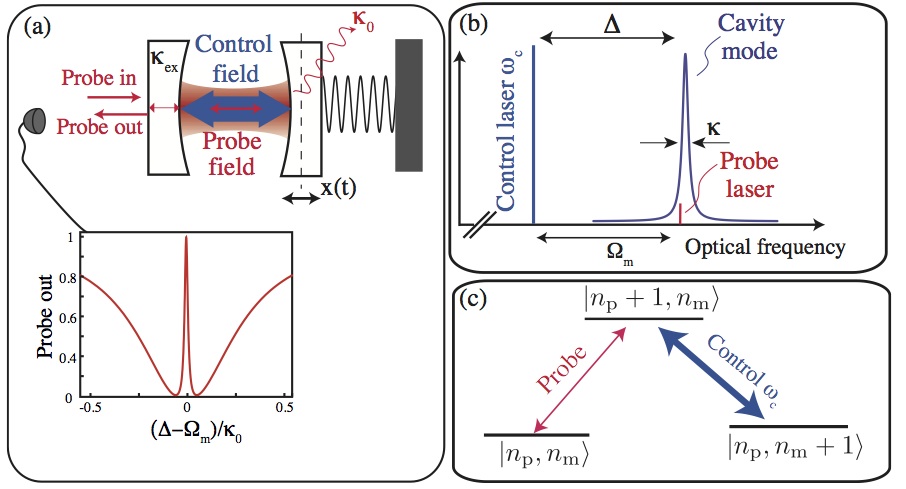
Quantum optomechanical interaction generally observed in systems with ultra-high quality factor resonances in both mechanical and optical modes, allowing coherent exchange of information between these degrees of freedom (such interaction schematically depicted in figure below). The exchange is mediated by radiation pressure, where the photons in the optical mode can be red- or blue-shifted by creating or destroying a phonon in the mechanical mode. In this way the motion of a mechanical oscillator can be coupled to an optical resonance that allows both control and read-out of the mechanical mode.
One of the research interests of our group is to employ experimental research to investigate the interaction of coherent laser fields with nano and micro mechanical objects that can be used for quantum information. Ultimately, careful engineering of strong interaction of light with atom-like nanomechanical oscillators paves the way for fabricating aritifical atoms with tunable and controllable interactions.
Optical levitation of a cavity mirror. To reach the quantum regime with optomechanical systems, it is critical to minimize the thermalization and decoherence processes by reducing their coupling to environmental thermal reservoirs. Thus far, this has necessitated the use of cryogenic operating environments or complicated fabrication of nanostructures exhibiting phononic bandgap characteristics. One of the main sources of mechanical dissipation and low mechanical quality factor is the coupling to the reservoir via clamping and material supports. What if we could eliminate this clamping altogether? One way to eliminate clamping loss is to use an optical tweezer to trap an object. In these cases the scattering due to the optical trapping beam can lead to heating of the object and therefore creates a thermal mechanical state.
At the ANU (CQC2T- Lam group), we proposed and theoretically investigated possibility of scattering-free levitation of a macroscopic cavity mirror. The suspended mirror forms part of a low loss optical cavity. The proposed optical suspension will therefore be fully coherent. This can potentially lead to observation of an extremely high mechanical quality factor. The proposed levitation experiment is schematically depicted below.

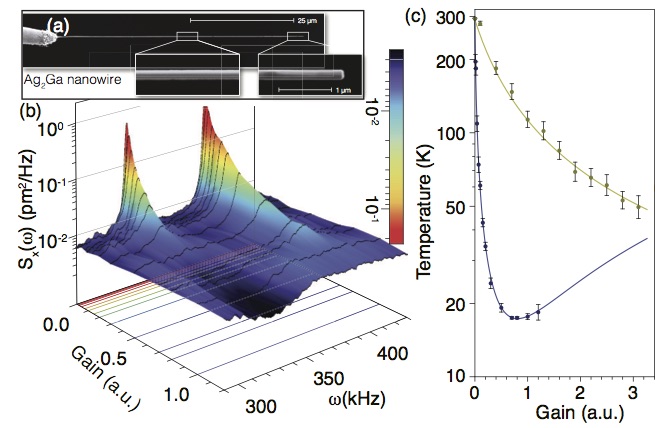
Nanowire photothermal cooling. Using homodyne detection of light scattered from a nanowire, at the ANU (PK Lam group), we reduced the thermal vibrations of the nanowire through photothermal feedback cooling and demonstrated multimode cooling. Image below shows an SEM image of the nanowire and the measured thermal noise and temperature of two vibrational modes of the nanowire.
Related Publications:
- G. Guccione, M. Hosseini, S. Adlong, M. Johnsson, J. Hope, B. Buchler, P. K. Lam “Scattering-Free Optical Levitation of a Cavity Mirror Using an Optical Spring”, Phys. Rev. Lett. 111, 183001 (2013).
- M. Hosseini, G. Guccione, H. J. Slatyer, B. C. Buchler and P. K. Lam “Multimode laser cooling and ultra-high sensitivity force sensing with nanowires”, Nature Communs. 5, 4663 (2014).